

Table of Contents
Introduction
Choosing a freelance skill can feel surprisingly difficult.
Search online and you will find lists recommending dozens of possibilities: content writing, graphic design, video editing, virtual assistance, SEO, web development, social media management, data entry, and many others.
The problem is not finding a skill.
The problem is choosing the right one for you.
Many beginners spend weeks jumping from one YouTube tutorial to another. They learn a little graphic design, try writing for a few days, watch videos about digital marketing, and then consider learning web development.
Eventually, they become overwhelmed and quit before becoming good enough at anything to offer it professionally. Learning how to choose a freelance skill can feel overwhelming when dozens of options appear profitable online.
If you want to start freelancing in 2026, you do not need ten different skills.
You need one useful skill that matches your abilities, interests, available time, and the problems businesses are willing to pay someone to solve.
This guide will show you how to choose a freelance skill without blindly following trends or wasting months learning something that does not suit you.
If you are completely new to freelancing, start with our complete guide on how to start freelancing with no experience in 2026, then use this article to make your first important decision
Why Choosing the Right Freelance Skill Matters
Your first freelance skill becomes the foundation of everything that follows.
It influences:
- What services you can offer
- Which clients you target
- What portfolio you build
- Which freelance platforms you use
- How you write your proposals
- How much you can eventually charge
- How easily you can develop into a specialist
Choosing badly does not mean you can never succeed. However, constantly changing direction can cost you valuable time.
For example, someone might spend three weeks learning graphic design, then decide video editing is better, followed by SEO, followed by virtual assistance.
After six months, they may know a little about everything but have no convincing portfolio in any one area. Depth is usually more valuable than collecting random skills.
That is why choosing one realistic skill and developing it consistently is a better starting strategy.
Start With What You Already Know
Before searching for the “best” freelance skill, look at your existing abilities. You may already possess skills that can be converted into freelance services.
The first step in learning how to choose a freelance skill is understanding what you are already good at and what you are willing to improve.
Ask yourself:
- What do people normally ask me for help with?
- What tasks have I performed at work?
- What subjects do I understand well?
- What software can I already use?
- What type of work do I enjoy?
- What can I learn without becoming frustrated?
Your previous employment can also reveal potential freelance skills. Someone who worked in administration may already have experience with:
- Data organization
- Microsoft Office
- Documentation
- Scheduling
- Customer communication
- Research
- Reporting
That person could potentially explore virtual assistance, administrative support, online research, or customer support rather than starting completely from zero.
Likewise, someone with marketing experience might investigate digital marketing, SEO, lead generation, proposal writing, or social media management.
Remember, your previous experience is an asset, not something you need to throw away when starting freelancing.
Identify the Problems You Can Solve
A common beginner mistake is choosing a skill simply because it sounds interesting. Clients do not usually hire freelancers because a skill sounds impressive.
They hire freelancers because they have a problem that needs solving.
For example:
A business does not necessarily want “SEO.”
It wants more visibility in search engines.
A business does not simply want “content writing.”
It wants useful articles that attract readers and support its marketing strategy.
A business does not necessarily want “virtual assistance.”
It wants someone who can reduce administrative workload.
This difference is important.
Instead of asking:
“What skill should I learn?”
Ask:
“What problem could I become good enough to solve for someone else?”
That question immediately makes your decision more practical.
Once you have a skill that can solve a specific problem, the next challenge is learning how to find freelance clients without experience and present your service effectively.
Consider These 5 Factors Before Choosing a Freelance Skill

1. Your Existing Strengths
The easiest skill to develop is often one that builds upon something you already understand.
For example, someone who enjoys writing may find content writing easier than coding.
Someone who is highly organized may naturally fit administrative support.
Someone who enjoys visual work may prefer graphic design or video editing.
You do not have to choose the easiest skill.
But starting with a natural advantage can make the learning process less frustrating.
2. Market Demand
Your skill must have potential buyers.
That does not mean you should chase every “hot skill” appearing on social media.
Instead, research whether businesses actually pay for the service.
Look at freelance marketplaces, job boards, company websites, and professional communities.
If you are comparing where beginners can offer their services, our guide to the best freelance platforms for beginners in 2026 can help you evaluate the main options.
Search for the service itself.
For example:
- SEO content writer
- Virtual assistant
- Social media manager
- WordPress specialist
- Video editor
- Graphic designer
- Email marketing specialist
Knowing how to choose a freelance skill based on real market demand can help you avoid spending months learning a service that has limited opportunities.
Current marketplace data provides useful evidence when researching demand. Upwork’s 2026 skills report shows continued demand across areas such as full-stack development, virtual assistance, data analytics, graphic design, SEO, social media marketing, sales and business development, while AI-related skills are also growing rapidly.
LinkedIn’s 2026 Skills on the Rise research also shows that employers are increasingly focusing on demonstrable skills, with areas such as business development, stakeholder communication, collaboration, and AI-related capabilities appearing among the growing skill categories.
Beginners can also explore our guide to freelancing skills for beginners in 2026 when comparing possible starting points
3. Learning Curve
Be realistic about how long it will take to become useful.
Some services can be practiced at a basic level relatively quickly.
Others require months or years of serious technical development.
That does not mean difficult skills are bad choices.
It simply means you should understand the commitment before starting.
If your goal is to begin earning relatively soon, choosing a skill that you can practice, demonstrate, and sell progressively may be more practical than spending a year studying before creating your first portfolio.
4. Your Ability to Create Proof
This is one of the most overlooked factors.
Ask:
Can I demonstrate this skill without having a paying client?
For writing, you can create sample articles.
For graphic design, you can create mock designs.
For social media management, you can build sample content calendars.
For virtual assistance, you can demonstrate administrative systems.
For SEO, you can perform sample keyword research or website audits.
This matters because beginners usually lack testimonials and client history.
A portfolio can compensate for some of that missing experience.
Part of knowing how to choose a freelance skill is asking whether you can demonstrate your ability through practical work, even before you have a paying client.
Our guide on how to build a freelance portfolio with no experience explains how beginners can create evidence of their abilities before obtaining paid projects.
5. Long-Term Potential
Do not choose a skill only because you think it will make money quickly.
Think about where the skill could take you.
For example:
Content writing → SEO writing → content strategy → SEO consulting
Or:
Virtual assistance → executive assistance → operations support → project management
Or:
Graphic design → brand design → creative direction
The first service you sell does not have to be your final career.
Your initial skill can become the foundation for a more specialized career.
Which Freelance Skills Are Good for Beginners?
There is no single “best” freelance skill for everyone.
However, several categories can provide realistic starting points depending on your background.
Content Writing
Content writing can be suitable for people who enjoy researching, explaining ideas, and communicating clearly.
Possible services include:
- Blog articles
- Website content
- Product descriptions
- SEO articles
- Email content
It is also relatively easy to create sample work before finding clients.
Virtual Assistance
Virtual assistance may suit organized people who enjoy administrative work.
Services can include:
- Email management
- Calendar management
- Online research
- Data organization
- Document preparation
- Customer support
It can also provide a pathway toward more advanced administrative and operations roles.
Search Engine Optimization (SEO)
SEO is broader than simply writing articles.
Beginners can start by learning areas such as:
- Keyword research
- On-page SEO
- Content optimization
- Internal linking
- Basic website audits
As knowledge improves, SEO can develop into a more specialized service.
Social Media Management
Social media management may suit people who understand online communication and enjoy creating organized content.
A beginner could start by learning:
- Content scheduling
- Basic graphic creation
- Caption writing
- Content calendars
- Audience engagement
- Basic analytics
The key is not simply knowing how to post.
It is understanding why a business should post something and what result it is trying to achieve within a time period.
Video Editing and Graphic Design
Visual skills continue to have applications across marketing and online business.
However, competition can be significant.
Beginners should therefore avoid presenting themselves as experts immediately.
Build a small portfolio first.
Create several strong samples and gradually specialize.
Case Study: Choosing a Skill Based on Existing Experience
Consider a fictional beginner named Ahmed.
Ahmed wants to start freelancing but does not know which skill to choose.
He considers coding because he has heard developers earn good money.
He watches several tutorials but quickly realizes that he does not enjoy technical programming.
He then considers graphic design.
Again, he struggles.
Finally, he looks at his existing experience.
Ahmed has worked in an office for several years. He regularly prepares documents, manages spreadsheets, communicates with customers, organizes appointments, and researches information online.
Instead of starting completely from zero, he chooses virtual assistance.
Within a few weeks, he creates sample administrative projects and builds a simple portfolio.
The important lesson is not that virtual assistance is automatically better than coding or graphic design.
The lesson is this:
Ahmed chose a skill that matched his existing strengths.
That gave him a much more realistic starting point.
Case Study: When Your First Skill Does Not Become Your Final Skill
Now consider another beginner, Sara.
Sara enjoys writing.
She starts with general blog writing and creates several sample articles.
After working on different projects, she discovers that she particularly enjoys researching keywords and improving articles for search engines.
Instead of abandoning writing, she adds SEO to her existing skill.
Her progression becomes:
Writing → SEO writing → Content optimization → SEO content strategy
This is called building a complementary skill set.
You do not necessarily need to start again every time you discover something new.
Sometimes the smarter approach is to add one skill to the foundation you already have.
Recent research on freelance knowledge workers also shows that freelancers increasingly use generative AI to support learning and skill development, while still relying on human judgment and verification.
Do Not Choose a Skill Just Because It Pays the Most
This deserves special attention.
You will constantly see claims such as:
“Learn this skill and make $10,000 a month.”
Be careful.
High earning potential does not mean high beginner income.
A skill can have excellent long-term earning potential while still requiring significant training and experience.
Your first goal should be:
Become useful.
Then:
Become reliable.
Then:
Become specialized.
Then:
Increase your rates.
This is a much healthier path than choosing a skill purely because someone on social media promises fast money.
How to Test a Freelance Skill Before Committing
You do not have to spend six months deciding. Use a simple seven-day test. A practical way to learn how to choose a freelance skill is to test it before making a long-term commitment.
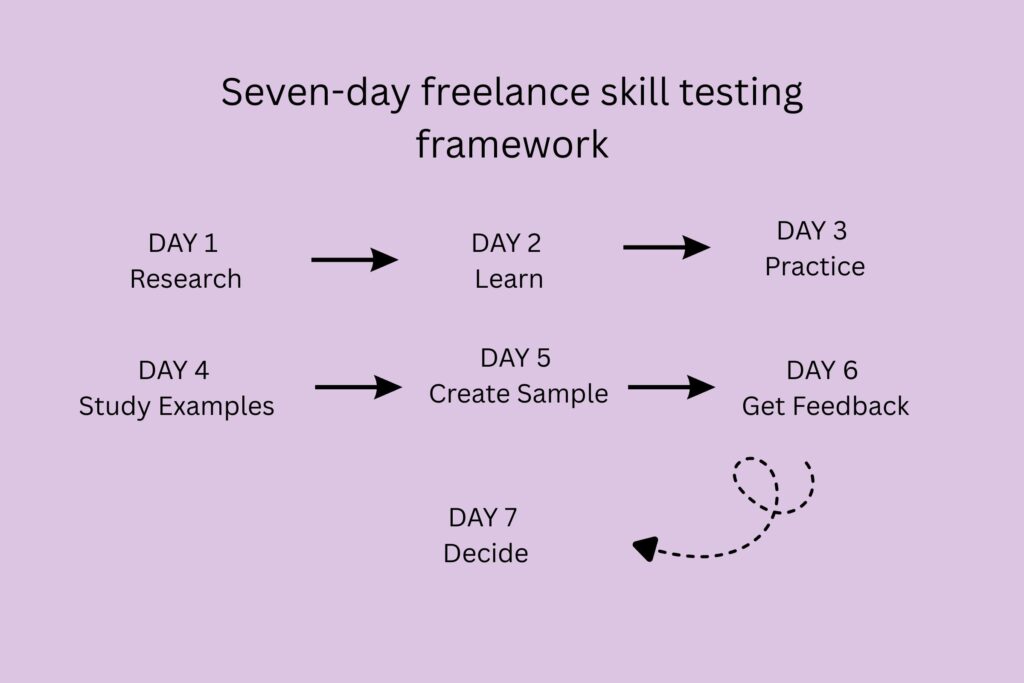
Day 1 – Research
Study what the skill actually involves.
Look at real freelance job descriptions.
Day 2 – Learn the Basics
Use free educational resources to understand the fundamentals.
Day 3 – Practice
Perform a small project yourself.
Day 4 – Study Real Examples
Look at professional work and identify what makes it good.
Day 5 – Create Your Own Sample
Create something that could eventually become part of your portfolio.
Day 6 – Get Feedback
Ask someone knowledgeable to review your work or compare it against professional examples.
Day 7 – Decide
Ask yourself:
- Did I enjoy the work?
- Can I improve with practice?
- Can I create portfolio samples?
- Are businesses paying for this service?
- Can I imagine doing this consistently?
If the answer to most questions is yes, give the skill a serious 30–90 day commitment.
Should You Learn More Than One Freelance Skill?
Eventually, yes.
At the beginning, usually no.
Learning multiple complementary skills becomes powerful after you have developed a strong foundation.
For example:
Writing + SEO
is stronger than simply saying:
“I am a writer.”
Similarly:
Virtual assistance + project management
can create a more valuable service than basic administrative support alone.
But beginners should avoid collecting skills simply for the sake of having a longer profile.
One strong skill plus one useful complementary skill is usually better than ten weak skills.
What to Do After Choosing Your Freelance Skill
Once you have selected your skill, stop researching endlessly.
Start building.
Your next steps should be:
- Learn the fundamentals.
- Practice consistently.
- Create 2–4 strong portfolio samples.
- Build a professional freelance profile.
- Start applying for suitable projects.
- Improve after every rejection or client interaction.
- Collect testimonials after completing successful projects.
If you prefer to find clients without relying entirely on freelance marketplaces, learn how to find freelance clients without job platforms and build a more direct approach to client acquisition.
Your portfolio does not need to be perfect.
Your first profile does not need to be perfect.
Your first proposal will probably not be perfect either.
The goal is to improve through actual practice.
If you already have a skill and are ready to look for your first opportunity, our guide on how to get your first freelance client with no experience takes you through the next stage.
Final Thoughts
The right freelance skill is not necessarily the one with the highest advertised income.
It is the one that sits at the intersection of your existing abilities, genuine interest, market demand, learnability, and your ability to demonstrate useful results.
Ultimately, learning how to choose a freelance skill is about finding the right balance between your strengths, market demand, learning ability, and long-term goals.
Do not spend six months searching for the perfect answer.
Choose one sensible direction.
Learn it.
Practice it.
Build proof.
Then take it to the market.
And remember: your first freelance skill does not have to define the rest of your career.
It simply needs to give you a strong enough foundation to take the first step.
Ready to Choose Your Freelance Skill?
Don’t close this article and continue researching another twenty lists.
Take a piece of paper and write down three skills you could realistically offer.
Now score each one from 1–5 for:
- Existing experience
- Interest
- Market demand
- Learning difficulty
- Portfolio potential
- Long-term growth
Choose the highest-scoring option.
Then commit to it for the next 30 days.
After choosing your skill, return to our guide on how to start freelancing with no experience in 2026 and follow the roadmap.
Then build your proof, create your portfolio, and start approaching clients.
You do not need to know everything before you begin. You need to choose a direction and start getting better at it.
Frequently Asked Questions
What is the best freelance skill for beginners in 2026?
There is no single best skill for everyone. Content writing, virtual assistance, SEO, social media management, graphic design, and video editing can all provide possible starting points depending on your abilities and interests.
How do I know which freelance skill is right for me?
Consider your existing experience, interests, learning ability, market demand, and whether you can create portfolio samples without having paying clients.
Can I learn a freelance skill without spending money?
Yes. Many skills can be practiced using free educational resources and free or low-cost tools. However, becoming genuinely proficient requires consistent practice rather than simply watching tutorials.
Should I learn multiple freelance skills at once?
Beginners are usually better off developing one core skill first. Once you become competent, adding a complementary skill can make your services more valuable.
How long should I spend learning a freelance skill before looking for clients?
You do not necessarily need to wait until you feel like an expert. Once you can produce competent work and demonstrate it through several portfolio samples, you can begin applying for appropriate beginner-level projects while continuing to improve.
Can AI replace beginner freelance skills?
AI is changing many freelance tasks, but it does not eliminate the need for people who can understand client requirements, check accuracy, make decisions, communicate clearly, and produce useful outcomes. Recent research on freelance knowledge workers also highlights both the growing use of generative AI for learning and the continuing need for human judgment and verification.
What should I do after choosing my freelance skill?
Learn the fundamentals, practice, create portfolio samples, build a professional profile, and begin looking for suitable clients. Do not wait indefinitely for perfect skills before entering the market.